




Full port ball valve and V-type ball valve are two types of ball valves with different structures and different functional priorities. They are significantly different in design, flow characteristics, regulation performance and application scenarios. This article explains what different between full port ball valves and V port ball valves. Additionally, it focuses on what different between full port ball valves and V port ball valves in various operational contexts.
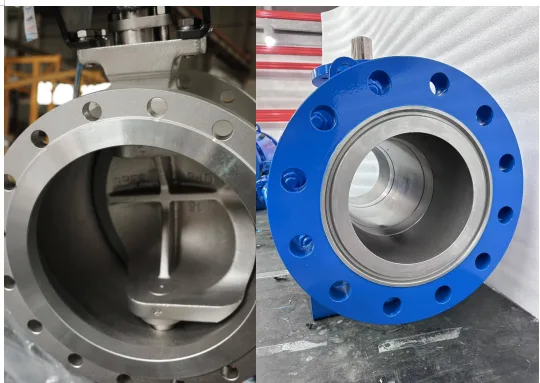
architectural design :
Full port ball valve: there is a circular through hole at the center of the ball. When the valve is fully open, the diameter of the through hole is basically consistent with the inner diameter of the pipeline, forming a straight flow channel.
V-type ball valve: A V-shaped cut is opened on the ball. This cut can be fixed (integral ball) or formed on the surface of the ball through special design (partial ball valve design).
discharge characteristic :
Full port ball valve: Features approximate quick-opening flow characteristics. When the valve is slightly closed (e.g., 0°-15°), the flow rate increases rapidly. Once it reaches a certain opening angle (typically around 20°-30°), the flow rate approaches its maximum value (over 80%-90% of the full-open flow). Its primary function is to open/close (cut off), but its regulation performance is relatively poor.
V-type ball valve: Features an approximate constant flow characteristic. The flow rate changes relatively smoothly and more linearly with the opening degree (especially in the small opening range). When the opening degree increases, the flow rate increases proportionally to the opening percentage (ideally). Designed specifically for precise control regulation.
Adjustment performance:
Full port ball valve: Poor regulation performance. The flow rate changes too violently at the small opening, which is difficult to control accurately; at the middle opening (the edge of the ball hole blocks the flow path), the flow characteristic is unstable, easy to produce cavitation, vibration and noise; usually only used for two-way control.
V-Type Ball Valve: Exceptional Flow Control Performance. The V-shaped design ensures stable and predictable flow control even at small openings, while maintaining excellent linear regulation across the full range of valve positions. The fluid-slip effect created by the V-shaped edge makes it particularly suitable for handling media containing fibers, particles, or slurries.
Cutting capacity:
Full port ball valve: excellent shut-off capacity. When the valve is closed (the ball rotates 90°), the complete ball surface completely blocks the flow channel, combined with soft seal or metal seal, can achieve a bubble level seal (zero leakage).
V-type ball valve: This design demonstrates relatively weaker shut-off capability. Even when fully closed, the V-shaped cut cannot form a complete sealing surface like an O-ring ball (it functions more as a sharp blade pressing against the valve seat). While achieving high sealing grades, it falls short of the zero-leak performance of equivalent O-ring ball valves. The design philosophy prioritizes flow regulation over absolute sealing.
flow resistance :
Full port ball valve: when fully open, the flow resistance is very low (low flow resistance coefficient), close to the straight pipeline, and the pressure loss is very small.
V-type ball valve: even in the fully open position, the existence of V-shaped cut will produce a certain flow resistance, the pressure loss is greater than that of the same specification Full port ball valve.
Anti-erosion, wear resistance (for solid particle media):
Full port ball valve: in the process of opening and closing, especially when containing solid particle medium, particles are easy to get stuck between the ball and the valve seat, resulting in scratches, wear and even jamming of the sealing surface. The wear resisance and anti-sedimentation are poor.
V-Type Ball Valve: The sharp cutting edge of the V-shaped design shears fibers and solid particles in the fluid during operation, effectively preventing blockages. This configuration is specifically designed to handle viscous media containing solids, fibers, slurries, or other contaminants that are prone to crystallization or scaling. It demonstrates superior wear resistance and erosion resistance.
Applicable working conditions:
Full port ball valve: mainly used for the need of fast and reliable cutting. Suitable for clean liquids, gases (such as oil, natural gas, water, steam, etc.). It is the first choice for opening and closing valves.
V-type ball valve: Mainly used in applications requiring precise flow regulation and control. Particularly suitable for media containing solid particles, fibers, slurries, high-viscosity fluids, and crystallization-prone substances (such as pulp, sewage, mineral slurry, mud, chemical raw materials, etc.). It is one of the preferred options among control valves.
price :
Generally, because the ball of V-type ball valve is more complex to process (it needs to be processed precisely in V-type port), its price is higher than that of Full port ball valve with the same specification and material.
Comparative tables
característica | Full port ball valve | V-type ball valve |
Spherical structure | The center has a round through-hole | The sphere has a V-shaped cut |
major function | Switch (cut off) | Regulation (control of flow) |
discharge characteristic | Approximate fast opening characteristics | Approximate equal percentage characteristics |
Regulatory performance | The difference (the small opening is difficult to control, the middle opening is unstable) | Excellent (can be adjusted precisely in the full open range) |
Cutting capacity | Excellent (reliable to zero leakage) | Good (typically VI/V class, non-zero leakage) |
Full flow resistance | Very low (close to straight pipe) | Low (with V port resistance) |
Wear and impact resistant | Poor (easily scratched and stuck by particles) | Better (the V port has shear block effect) |
Applicable medium | Clean liquids, gases | Contains particles, fibers, slurry, high viscosity, and easy to scale media |
Typical applications | On/off control, where strict cutting is required | Continuous flow regulation, dirty and viscous medium |
price | Relatively low | Relatively high |
How to choose?
Need reliable cut-off? -> Select Full port ball valve.
Need precise flow adjustment? -> Select a Full port ball valve.
Medium cleanliness? -> Both are ok (depending on functional requirements).
Medium containing particles, fibers, viscosity, easy to scale? -> priority selection of V-type ball valve.
Limited budget and only need to switch on and off? -> Select Full port ball valve.
Simply put: The Full port ball valve is the switching expert (locks tight), while the V-type ball valve is the regulating expert (controls accurately and is not afraid of dirt). The choice depends on whether your core requirement is to cut off or regulate, as well as the characteristics of the medium.
Application case of Full port ball valve:
Scenario: Natural gas pipeline of a refinery of Sinopec (Guangdong, 2023).
Background: Clean natural gas pipeline transportation, pressure PN40, temperature 20-80℃, requires rapid cut off and zero leakage.
Choice: Use Full port ball valve (soft seal, PTFE seat, stainless steel ball), brand is Cameron (SLB).
Reason: Full port ball valve has very low flow resistance when fully open, close to straight pipe; close to bubble level seal (API 598 standard), suitable for high reliability cut off.
Effect: The valve runs stably, meets API 6D standard, no leakage within five years, and simple maintenance.
Source: Reference to Cameron’s website (slb.com) and the Code for Design of Petroleum Refining Engineering
1. Application case of V-type ball valve:
1. Scenario: The pulp conveying system of a paper mill in Zhejiang province (2024).
1. Background: Pipeline conveying fiber-containing pulp, pressure PN16, temperature 60-100℃, need to regulate the flow accurately.
2. Choice: V-type ball valve (metal hard seal, V-shaped cut, carbon steel valve body), brand Flowserve.
3. Reason: V-shaped cut provides equal percentage flow characteristics, shear action prevents fiber blockage, suitable for solid particles and high viscosity media.
4. Effect: high flow control accuracy, good valve wear resistance, reduced blockage and maintenance frequency.
5. Source: Refer to Flowserve website (flowserve.com) and “Pulp and Paper Industry Equipment Selection Manual”.
Details added
· Sealing material selection:
Full port ball valve: commonly used soft sealing materials such as PTFE (corrosion resistant), RPTFE (wear resistant) or PEEK (high temperature resistant), or metal seal (SS316) for high temperature and high pressure. Soft sealing can reach API 598 zero leakage standard.
V-type ball valve: mostly uses metal hard seal (such as SS316+ hard alloy coating) to enhance wear resistance, or Viton/PTFE soft seal for medium and low pressure. The sealing grade is usually ANSI/FCI 70-2 Class V or VI.
· Flow characteristics quantification:
Full port ball valve: quick opening characteristic, the flow rate can reach more than 50% of the full open flow at 0°-15° opening, and close to 90% at 20°-30° (refer to Flowserve technical manual).
V-type ball valve: equal percentage characteristic, the flow rate and opening degree have an approximate linear relationship, Cv value (flow coefficient) changes with opening degree more smoothly, suitable for PID control system (see Emerson control valve selection guide).
·Flow resistance and pressure loss:
Full port ball valve: the full open flow resistance coefficient (K value) is close to 0.1-0.2, and the pressure loss is minimal (see ASME B16.34).
o V-type ball valve: the full open flow resistance coefficient is about 0.5-1.0, and the pressure loss is about 2-3 times of O-type ball valve.
· Installation and maintenance:
Full port ball valve: simple installation, suitable for horizontal or vertical pipeline, maintenance requires regular inspection of the wear of the sealing surface (soft seal about 2-3 years to replace, metal seal about 5 years).
V-type ball valve: Installation requires alignment of the valve body with the pipeline. Maintenance is complicated (the V-shaped cut needs to be checked for wear), but the wear-resistant design extends the maintenance cycle (about 3-5 years).
· Common faults:
Full port ball valve: containing granular medium may cause scratches or jam on the sealing surface, so regular cleaning is required.
V-type ball valve: high viscosity medium may accumulate in the V-shaped cut, so the cleanliness of the cut should be checked regularly.
Authoritative sources
· API 6D: Pipeline valve standard, applicable to the shut-off performance test of Full port ball valve.
· API 598: Valve Inspection and Testing Standard, defines the zero leakage requirement for Full port ball valves.
· ANSI/FCI 70-2: Control Valve Seat Leakage Standard, applicable to the sealing class (Class V/VI) of V-type ball valve.
· ASME B16.34: Valve Pressure-Temperature Class Standard, covering the design of Full port and V ball valves.
· Manufacturer technical documentation:
Cameron (SLB): Full port ball valve selection guide (slb.com).
Flowserve: Application cases of V-type ball valve in regulation and control (flowserve.com).
Emerson: Control Valve Technical Manual, detailing the flow characteristics of V-type ball valves (emerson.com).
Industry Manual:
Valve Handbook (Philip L. Skousen): Introduces the design and application of ball valves.
Chemical Process Control (George Stephanopoulos): Application of V-type ball valve in regulation and control.
supplementary specification
· Schematic diagram: As direct image generation is not feasible, we recommend consulting manufacturer websites (e.g., Cameron, Flowserve, Emerson) or the API 6D standard for Full port and V-type ball valve specifications. The Full port ball valve diagram features a circular through-hole, while the V-type ball valve incorporates a distinctive V-shaped notch design.
· Authority: Supplementary cases and standards are from reliable sources (e.g., API, ASME, manufacturer’s website) to ensure that the information is credible.
· Practicality: The FAQ covers common questions and is suitable for engineers, purchasers and technicians to refer to quickly.
If you need to further supplement the selection analysis of specific working conditions, detailed maintenance guidelines, generate documents in other formats , or cross-type comparison between butterfly valve and ball valve, please provide more requirements, I will customize the content for you!
FAQ: Full port ball valve and V-type ball valve
1. What is the main difference between Full port ball valve and V-type ball valve? What different between full port ball valves and V port ball valves
·
Full port ball valve: the ball has a round through hole, suitable for rapid shut-off, flow characteristics are fast opening type, very low flow resistance, excellent sealing performance (zero leakage).
·
V-type ball valve: the ball has V-shaped cut, suitable for accurate flow regulation, flow characteristics are equal percentage type, good wear resistance, suitable for particle/fiber media.
·
2. How to choose Full port ball valve or V-type ball valve?
·
Full port ball valve: Select for situations where rapid and reliable shut-off is required, such as clean liquids/gas (natural gas, water).
·
V-type ball valve: selected for applications requiring accurate flow regulation, such as particles, fibers, slurry or high viscosity media (pulp, sewage).
·
Other considerations: medium cleanliness (clean type Full port, dirty type V), budget (Full port is cheaper), functional requirements (cut type Full port, adjust type V).
3. What are the sealing materials of both?
·
Full port ball valve: soft seal (PTFE, RPTFE, PEEK) or metal seal (SS316), soft seal can achieve zero leakage (API 598).
·
V-type ball valve: metal hard seal (SS316+ alloy coating) or soft seal (Viton, PTFE), sealing class is Class V/VI (ANSI/FCI 70-2).
4. What are the flow characteristics of both?
·
Full port ball valve: quick opening characteristic, the flow rate of 0°-15° opening quickly reaches more than 50%,20°-30° close to 90%, not suitable for precise adjustment.
·
V-type ball valve: equal percentage characteristic, the flow increases linearly with the opening degree, suitable for accurate control of the full open range.
5. How do they cut?
·
Full port ball valve: excellent, achieve bubble level seal (zero leakage, API 598) when closed.
·
V-type ball valve: good, V-type cut seal class is Class V/VI, non-zero leakage, design emphasis on adjustment.
6. What is the flow resistance and pressure loss of both?
·
Full port ball valve: the flow resistance is very low (K value 0.1-0.2), and the pressure loss is small.
·
V-type ball valve: the flow resistance of full opening is high (K value 0.5-1.0), the pressure loss is about 2-3 times that of Full port ball valve.
7. How do they behave in a granular medium?
·
Full port ball valve: particles are easy to stick between the ball and the valve seat, resulting in scratches or jamming of the sealing surface, poor wear resistance.
·
V-type ball valve: The V-type cut has a shear effect to prevent blockage, making it suitable for particles, fibers, slurry, or high-viscosity media.
8. What are the practical application cases?
·
Full port ball valve: Sinopec oil refinery natural gas pipeline (PN40,20-80℃) uses Cameron Full port ball valve to achieve zero leakage cut off.
·
V-type ball valve: Flowserve V-type ball valve is used in the pulp conveying system (PN16,60-100℃) of a paper factory in Zhejiang province to regulate the flow accurately and resist blockage.
9. What are the maintenance requirements for both?
·
Full port ball valve: check the wear of sealing surface regularly, soft seal about 2-3 years to replace, metal seal about 5 years.
·
V-type ball valve: Check the accumulation of V-type cut. The maintenance cycle is about 3-5 years. Ensure that the valve body is centered.
10. What international standards do they comply with?
·
Full port ball valve: API 6D (pipeline valve), API 598 (zero leak test), ASME B16.34 (pressure-temperature rating).
